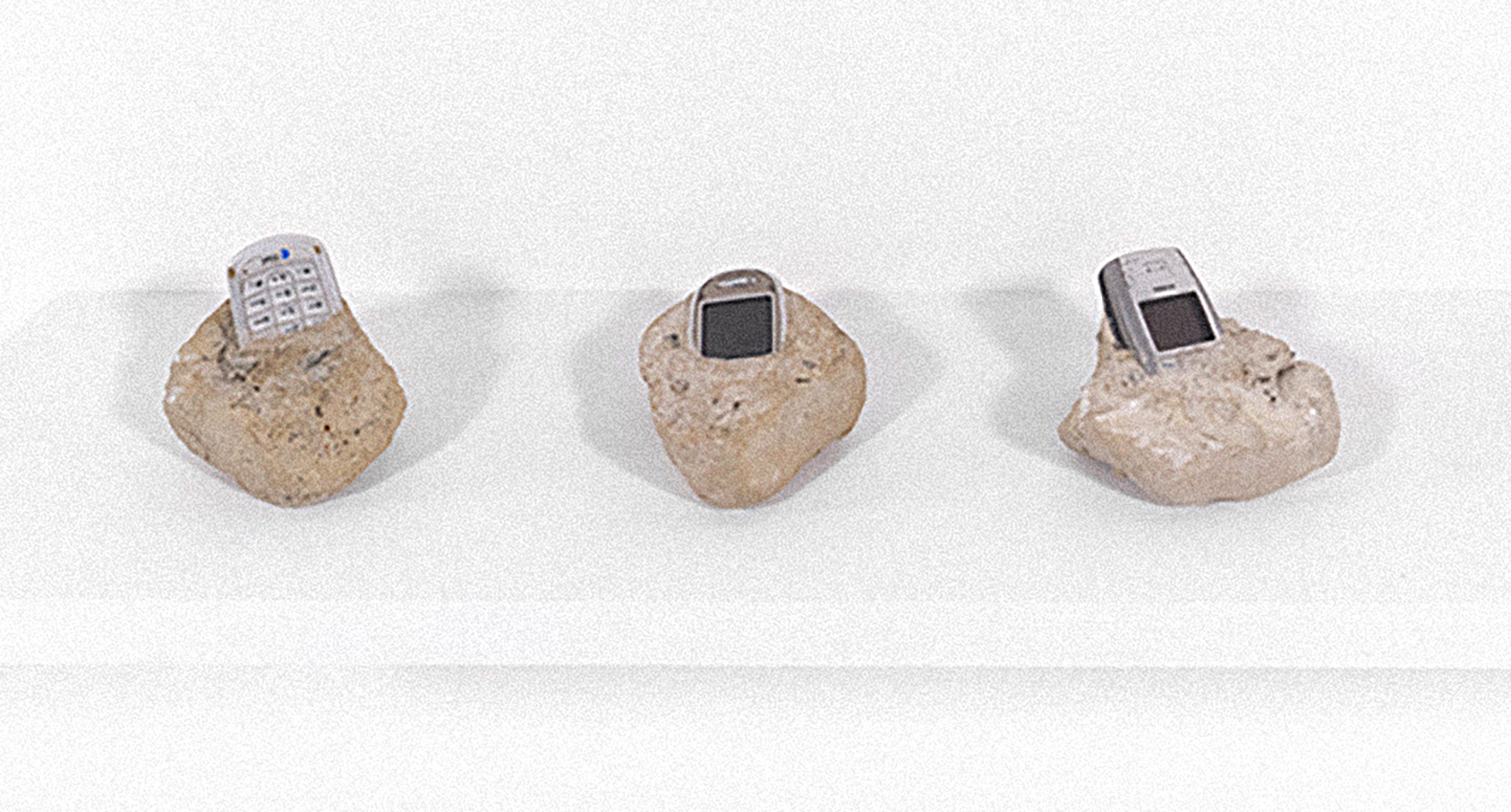
My friendship with kathy wu is sustained in part by our attention to military technology; its cost to life, labor, and land; and poetics that make visible the greedy sprawl and elusive supply chain of the military industrial complex.
kathy’s poetry collection She Will Last as Long as Stones (Wendy’s Subway 2025) mines data from the United States Geological Survey and serves as a counter-survey of its own. If the intended purpose of the USGS is to “study the nation’s lands and resources,” translating the subterranean into data that is quantifiable, manageable, and extractable, then kathy studies what is left unaccounted: The labor required to mine and transform the “raw material” of the earth. The networked dependencies of human and nonhuman life that produce commoditized technologies. The overlapping scales of geologic, computational, labor, and sick time that are funneled into, but in excess of, capitalist time.
One of the many touchstones that kathy and I share is the anthology Iron Moon (2015), a collection of translated poetry written by Chinese factory workers. Xu Lizhi was one such worker-poet who assembled iPhones for the Shenzhen factory of Foxconn, the Taiwanese electronics conglomerate. In 2014, Xu took his life at the age of 24. He came to represent the rage and the struggle of Chinese factory workers, many of whom migrated from rural China to take up construction and service work in the cities, as well as manufacturing for multinational companies that prey on cheap labor, favorable tax rates, and lax environmental regulation. In one poem, Xu writes that he “swallowed a moon made of iron,” that he “swallowed a life overtaken by rust.” In these lines, Xu captures the cruel porosity between flesh and metal, between living labor and global commodity, between protest and elegy, between end-of-life and slow death.
It is fitting, then, for kathy’s book to begin with an epigraph from the Martiniquan poet and philosopher Édouard Glissant: “Let us never forget: that the poem was entombed in a collapse of the earth… But we’re also waiting for the renewed perception of differences… and for the poem to reemerge once more.”
—basalt hsu
BH: Who or what brought you to poetry as a field of attention? In a world that is run as a death machine, how did you come to poetics as a practice of attention, or even of locating beauty?
KW: When I was a kid, I was obsessed with the potential of a page. Anything could happen when I was working with the line—whether a line of poetry or in image.
What happens when a line gains consciousness and meaning? My work thinks about language as material, as collage, as play, a line that connects me to you. I’m inspired by artists like Kameelah Janan Rasheed—artists who use language as material, who think about the word and the archive as a living thing. A container to hold pluralities.
As someone who also works with art and design, I ask, when does text become image? When does image become text, become transmuted into the other? And then being interested in what the page can and can’t do—what the body and voice can do instead.
From a more personal place, my poetics is situated within and against my upbringing in diaspora. Both my parents came to the US from China in the 1990s, post-Immigration Act. There was instability and chaos in my family life, which also came with rigidity and control. I spent a lot of my life being very disembodied. Poetics was a way to sometimes be embodied, or to experiment with modes of thinking in and outside the body.
My parents valued science and state knowledge, and I grew up with a very particular relationship to knowledge: What counts as knowledge, and what are ways to know? Language is a set of rules and a way to approach knowing, while poetics offers a capaciousness.
There were years I didn’t engage in poetics because I associated it too strongly with the pastoral, which felt synonymous with beauty. These days, I find possibility in thinking about how we know, and muddying that authority of knowledge. Maybe my true feelings about beauty are in that muddiness.
BH: You’ve talked about how your parents both worked in some form of technology? How do you turn to patterns of migration and labor as an archive?
KW: My parents immigrated to the US, to Tucson, Arizona to work in the semiconductor field. My parents both engineered microchips, working with almost imperceivably small components at a high level of abstraction. It is interesting to me, as an adult, to not know exactly what they were doing, or how it was being used. If it’s a tiny thing that makes a signal wave bigger, at what point is it used for military technology?
We’ve talked about Iron Moon, an anthology of Chinese migrant labor poetry named after Xu Lizhi’s poem. Xu Lizhi of course, being the young Foxconn worker on iPhone assembly lines who became emblematic of the movement. When I found that anthology in 2017, I was like, oh, there’s people at every single point in the supply chain. There are poems at every single point in the supply chain. That made me want to think more seriously about using the products as an entryway into lineages, rather than thinking about migration at the level of nation-states or symbolic ancestral hometowns.
BH: What does a poem mean to you?
KW: My gut instinct is that a poem is a moment that insists on its own interiority, agency, and point of view through language. It’s either separate from or frictive against authoritative narratives. It’s a moment of language which insists on being something else, at least other than in ways that language is used in domination.
BH: Your book opens with Glissant: “Let us never forget: that the poem was entombed in a collapse of the earth.” You insert us into both the lived reality of ecological crisis—genocide and extinction brought upon by Capital’s unfettered expansion and extraction—as well as the metaphor of excavation as it relates to memory work and archive. Why begin with ecological collapse? For language to emerge from a tomb?
KW: I was working with and against the genre of elegy in this text. It is literally about my mom’s death, but also questioned what we foreclose in thinking of extinction as elegy. Within elegy, there’s room for anger, protest, grief—all of which can be versions of love. But I didn’t want elegy to foreclose a future. Or rather, maybe things can end, but the ending can help us begin again.
One of my poems borrows language from Eunsong Kim and how she frames “Romance #1,” a list-poem of things that remain after the collapse of capitalism. Kim describes it as “part tribute and elegy to how life and extinction continue to be fantasized. It is titled ‘Romance #1’ because romance is an all-encompassing venture: all the emotions, all the body… This cannot be the ending. Yes?”
This last line is referenced in A FRAGMENTED LINEAR ACCOUNT: “This cannot be the ending, yes? Earthly goods cannot be the ending.” I wonder what it means to play with the edges of elegy, knowing there are more possibilities if we don't define it as such. What if we refuse an end or begin from an end?
The act of excavation—hopefully one that’s really slow—starts with both my own memory and experience, but extends beyond that. Rather than cementing any singular point of view, timescales and timelines become muddled, they overlap and intermingle.
To continue the metaphor of excavation, perhaps not everything needs to be explicitly “used” or narrativised in a clear history. I hope that in my poetics, I’m able to unearth and observe many things all at once, and move towards what Glissant refers to as a “renewed perception of differences.”
BH: I remember you telling me about putting the book together in residency at Blue Mountain—right after your mom passed? How was it for you, to work with grief and endings, at the scale of grief for your mother as well as the scale of weather during an El Niño period?
KW: Yeah, that was a very special and generous experience. That was my first artist residency, and it afforded a lot of slowness. We had limited internet. That summer there were intense wildfires from Canada, and there was smoke in the air. The rain caused my old car, which was my mom’s old car, to completely break down. It became completely saturated by the rain and I couldn’t leave for days.
In this environment of intense elemental energy, I made little artist books. Each one posed a question—maybe it was a question about time and geology, maybe one was a question about mourning and caretaking. My mom had passed a few months earlier; it was raining endlessly, and I was crying endlessly. I was navigating collapse at the personal scale of falling apart, but also things falling apart in a time of endless war. I think of Etel Adnan’s To Be In a Time of War, which moves between mundane living and imperialist violence. Her oscillations read as a score, a series of things to do and reflect on in the everyday: What does it mean to put the kettle on? What does it mean to watch the news?
BH: Mothers recur in your book, not just mother as biological mother, but motherboard as the central nervous system of circuitry, mother as mythic origin, mother as social reproduction. In line with extraction, I think too of motherlode, as a principle vein for the mining of metals. Who or what is the mother of this book of poems—mother as “living, deceased, or other?”
KW: Mother became an origin point to think about time and about kin. It’s a site of origination; it signals a beginning, and in that way is the opposite of—or complement to—elegy. Thinking of myself as a point again on this line of ancestry, maybe there’s this broader engagement with ancestry. Ancestors might be a narrative tool, they might extend to the non-human and the non-living too.
I feel complicated about tropes like “earth as a mother,” or mother tongue, or mother land—this mythic, pure way of relating to place and origin. And so mother as in motherlode, or motherboard in these like military or industrial contexts—these become non-pastoral renditions of mother.
In the case of motherlode, it signals abundance at a huge or infinite scale. There is this trope of mothers giving in one direction, of abundance moving without reciprocation. I wonder what it would be like to have abundance on both or all sides? To have tending in every direction? To your point about beginning with the end—perhaps via mothers, these conditions of endings and beginnings and loss and abundance are all commingling in the text.
Mothers as “living, deceased, or other” directly came from my experience as my mother’s caretaker and navigating healthcare bureaucracy with my family. I was thinking about languages of taxonomy, languages of the state, and ways of rendering people into data. Thinking about phone calls with insurance; thinking about illness, and a failure to function “properly” alongside capital. To this end, I look to folks working within disability poetics: JJJJJerome Ellis, Derek Jarman, Alvin Lucier, Christine Sun Kim, Finnegan Shannon. Their works challenge linguistic legibility as well as the imposition of categories, and teach me how expansive in-between spaces can be.
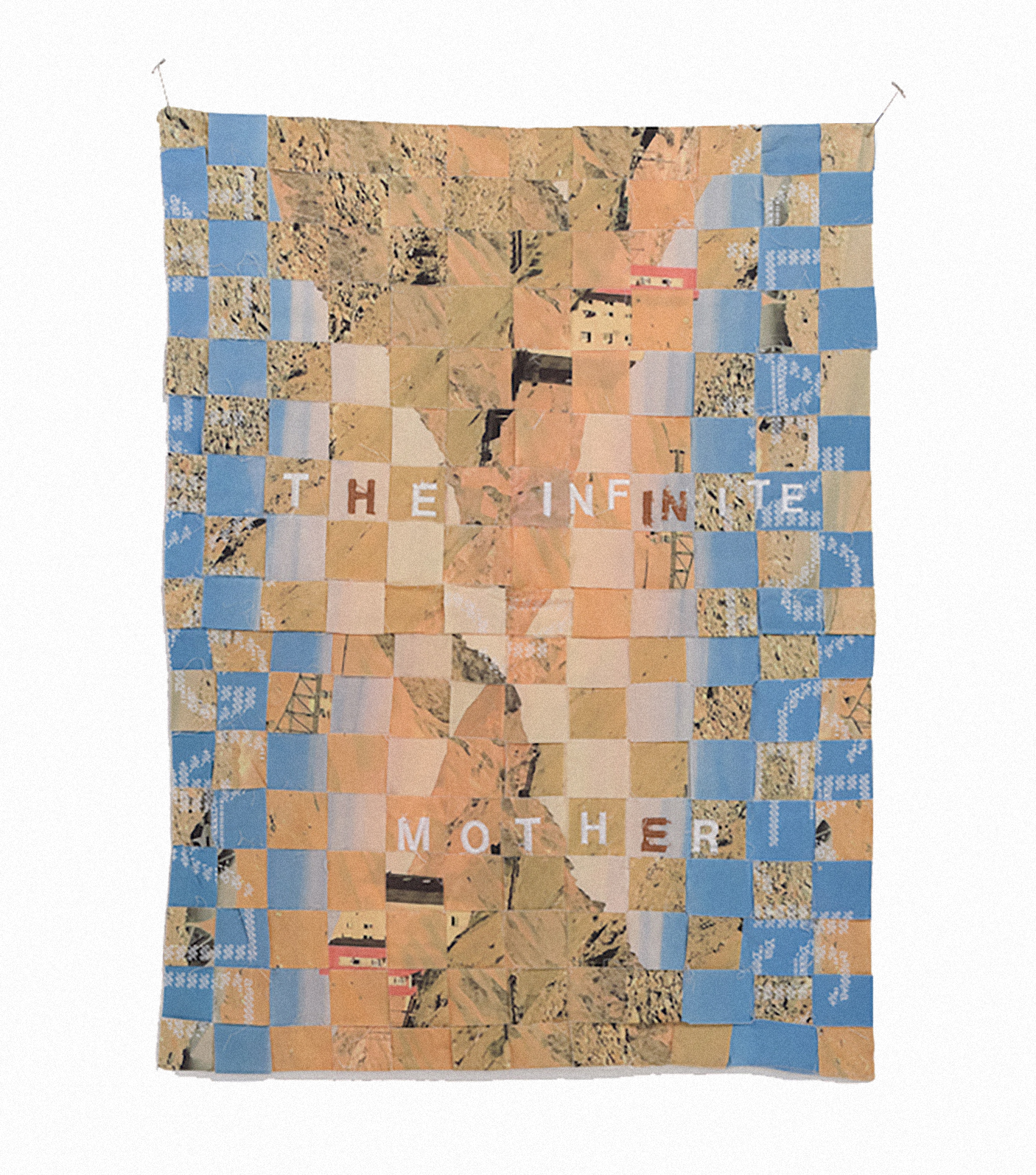
BH: You often make use of the very technologies developed through militarization—mylar, circuitry, AI-generated language—in your work. What is at stake for you when you deploy this type of source material? What does it mean to be resourceful as an artist in the context of resource extraction?
KW: I talk about this with my students when we make projects with computation—which originates from histories of war, histories of domination, histories of labor extraction. We agree that we’re not using the master’s tools to dismantle the master’s house. But when it becomes something that you can see and touch, when you’re holding the thing in your hand, it becomes less abstract. Because these materials originate from industries and economies of scale, I think being able to encounter them closely and intimately helps us think about that scale.
Relating it back to language: language can also be used as a mode of capture, or surveillance, or control—but it could also be a means of imagination or refiguration. I remember going to a talk by Dionne Brand where she talked about writing with the language of industry; she said, our water is already filled with microplastics. I interpret this as a poetics against the pure or pastoral, once again. The technology of now can also have poetics, and the garbage it’s creating also has a poetics.
If we’re witnessing a single industrial object at a very local scale, maybe we can listen to its past, present, and future. Lots of poets lean on etymology as a methodology, asking—in the case of materials—where did you come from? And before that? Etymology is imperfect but through that tracing, there can be a story that connects the thing to people or planet.
We’re interfacing with the ready-made object in art and life constantly. Could we contextualize those objects in a way which doesn't erase the labor of who made it and the provenance of it, but rather highlight it?
BH: In your notes, you write: “The poem begins on the planet: the Adirondack lakes; the Tucson deserts; the mine in Machalí, Chile; the city of Providence, Rhode Island on Narragansett land.” How do you triangulate the specificity of place between the mythic and the material?
KW: Materials become portals into certain histories, as well as certain projections and fantasies. Since writing this book, I’ve been spending more time with the history of other technologies. I was reading Rebecca Solnit’s River of Shadows, where she talks about Edward Muybridge’s documentation of California, tracing his work and image-making with the construction of the fantasy of the Western United States. W. J. T. Mitchell talks about landscape as enacting an ideology, which can transform or transfigure a place.
Place can be translated into so many things. It can be translated into a poem, it can be translated into different representations of memory. Place can also be translated into maps, mineral data. These are all different ways of looking at place that toe the line between seeing and surveilling. Some of these perceptions create new narratives and myths, where others might privilege a material, situated knowledge.
BH: One of your poems is named after Muriel Rukeyser’s The Book of the Dead. Rukeyser traveled to West Virginia to document and gather testimony around the Hawks Tunnel Disaster, in which hundreds of mining workers, the majority of them Black, developed often fatal lung disease because of working conditions in the construction of a dam. As someone who works to “extend the document,” to write against record, to archive the subterranean, what does it mean for you to travel the distance—maybe through site visitations, but also through collaborations and through teaching?
KW: I feel wary when something is abstract. It’s the difference between something couched in representation, versus life lived in a space, which is always detailed and specific. I'm grateful to my friend Aáron, who hosted me in Chile and translated everything when we visited the El Teniente mine and Sewell, its American mining town. El Teniente is the world’s largest underground copper mine. At different points in time, the Braden Copper Company, Kennecott Copper Company, and the Guggenheim Exploration Company all had interests in the mine. Thanks to Aáron and because of being on-site, I learned things like where the bosses lived, where the workers lived, but also, “Here's this lore about a woman who murdered her husband and turned him into an empanada.” I don't think I would have learned that in any particular archive.
We also met this elderly Chilean man who had grown up in the mining town. This is the first time he was back since he was a child. He was there with his family—I want to say 40 or 50 years later. That’s something that’s not in any particular archive. There’s this situatedness, this ephemerality of moment-to-moment experience that exceeds the historical, state, or company record—which also relates to Rukeyser’s engagement through orality.
I always cite Eunsong Kim's “FOUND FOUND FOUND, LIVED LIVED LIVED” as a way to think about how to engage with source materials. I’m thinking about what it means to live something versus to be legislated. Layli Long Solider uses personal insertion, or annotation at the level of state texts. I’m thinking about Forensic Architecture’s work, which is literally used in the institution of the law, and utilizes that view from above that satellite view as a kind of testimony. Legislation and surveillance are the most disembodied ways of seeing—imposing a singular point of view and control. We see artists like Long Soldier use and “mis-use” them to generative ends.
I’m also thinking about Basel Abbas and Ruanne Abou-Rahme’s new film, Prisoners of the Sun, where the artists worked within these longtime relationships with Palestinian political prisoners. The oral histories in the film describe personal stories in Israeli prisons, experiences with fugitivity, and what the artists speak to as “living in the negative.” I interpret this as a perspective from the margins of colonization and sometimes quite literally underground. Continuing literally, we might compare this to the satellite’s view from above, which extends the state’s view from above.
In thinking about “living” versus “being legislated,” we might return again to what it means to know—return to the poem inside Glissant’s “collapse” of orders, and to plural modes of holding truths.
The last thing I'll say about my time “on site”: I wasn’t visiting Sewell in any special capacity. Sewell is a UNESCO heritage site, and I bought a ticket to go on a day tour. Myth is made through things like tourism, memorialization. There’s a somber moment in the tour where we see this mural depicting the 1945 El Teniente mining fire, where 355 workers died from carbon monoxide poisoning. What it might mean for me, a random American person, to reckon with the image of this event—a memory which is not my memory. It comes back to, what are the limits of representation? What are the limits of memorialization, which is almost always representation?
BH: Across your performances, visual work, and writing, you work with things like the color blue, the weather, stones—deceptively simple concepts or objects that we take for granted in our everyday lives, that in fact belie a complex history of military technology. Why start with what is in plain sight? How can this change the way we see war?
KW: I’ve talked a lot about embodiment, about being there, because language comes from the body—it has to come from the body. What does that mean for poetry? When we attend to something in the world—like stones or the color blue, become a portal. We have a mundane relationship with these things, but what if we keep tracing them? Inevitably they can take us out somewhere far away. It’s etymology-as-method, again.
The Buddhist teacher Thich Nhat Hanh was exiled from Vietnam in the 1960s, during the time that the US was bombing Southeast Asia. He writes and teaches about everyday acts of attention and love, and gradually he increases the stakes and the scale of mindfulness work. With love—and without romance—he writes about transformation at the scale of war. Like mothers existing as kin on a point in the timeline, many things can become other things depending on how long you wait. For instance, he asks the reader to meditate on plastic, and how long it takes for plastic to become reconfigured into a flower. But you know what takes even longer? Nuclear waste—which takes so very long to transform into a flower.
Touching the mundane is an invitation into thinking about what exists with us at any given point in time, and to hold curiosity for the potential for transformation. This may not do the work of dismantling power, but maybe it opens the imagination to consider the latency in a single object or moment. It hasn’t always been this way, and it will once again be different in 10, 100, 1,000 years. Or—on the scale of nuclear timelines—10,000 or more years into the future.